
When you get married, everything you own automatically becomes joint property, which means that you are required by law to divide everything equally between the two of you in the event of divorce. This can be changed by making a prenuptial agreement that determines the division of financial matters in the event of a divorce.
There is several good reasons to get a prenup and the content may vary depending on your desires and needs. As an example, it may include the desire to protect assets such as a vacation home or a business so that it is not subject to division in case of divorce. Conversely, it may also include sharing pensions in the event of divorce, which also requires a prenuptial agreement, as the law states that usual pensions are not to be divided.
A prenuptial agreement can also be a good idea if your financial situations are different. For example, if one of you contributes with a larger fortune to the marriage, or if one has more debt than the other. By creating a prenuptial agreement, you can protect yourselves and each other if the marriage were to end. It is important to remember that a prenuptial agreement is not about lack of trust or lack of love in your relationship. On the contrary, it reflects responsibility and an investment in ensuring long-term success in the relationship.
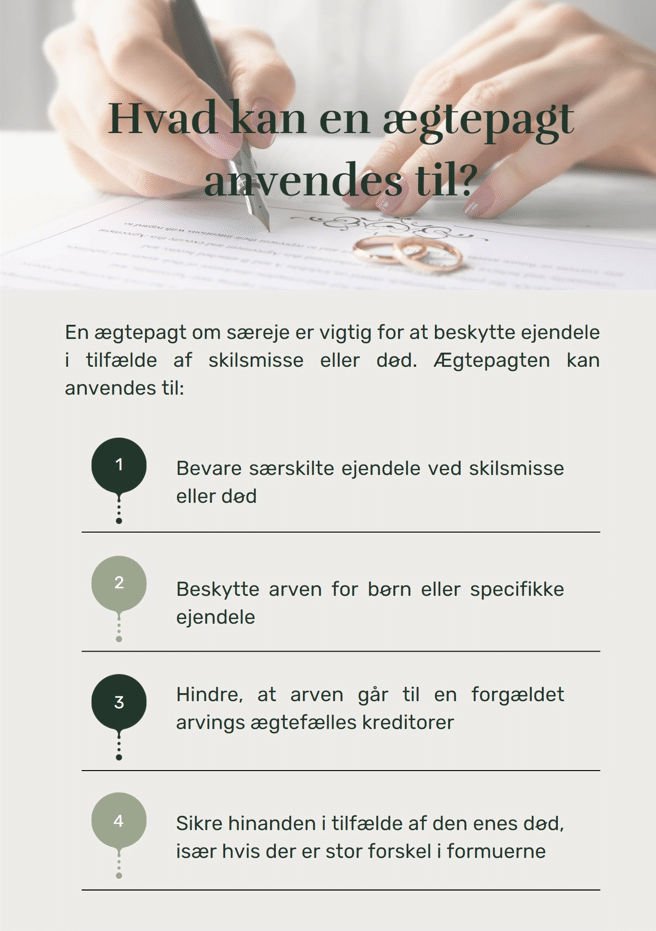
A prenuptial agreement regarding separate property is important to protect assets in the event of divorce or death. The prenuptial agreement can be used to:
A prenuptial agreement can be made before or during the marriage, but it must meet certain requirements to be valid. It is important to note that a prenuptial agreement is only valid if it is written, signed, and registered.


There are several types of separate property agreements, so it’s important to choose the one that suits your marriage and future desires. Here’s a brief summary of some types of separate property:
Divorce-only separate property: Functions as separate property only in the event of divorce but dissolves for both spouses upon one’s death. This type of separate property is typically not established in its pure as it is not beneficial.
Completely separate property: Functions as separate property in both divorce and death situations. Separate property is recommended if one spouse has significant debt that the other spouse should not be liable for.
Combined separate property: Functions as a combination of divorce-only separate property and complete separate property, where there is separate property in the event of divorce. In the event of death, the separate property becomes part of the deceased’s estate but remains separate property for the surviving spouse. This is the most commonly used separate property.
Fractional separate property: Functions as a set fraction of the spouse’s assets or entire property that is made into separate property.
Sum separate property: Functions as a specific sum of the spouse’s assets or entire property that is made into separate property.
Time-limited separate property: Functions as separate property for a specified period, after which the separate property expires.